Speech Studio: human-gated co-authorship for professional speeches
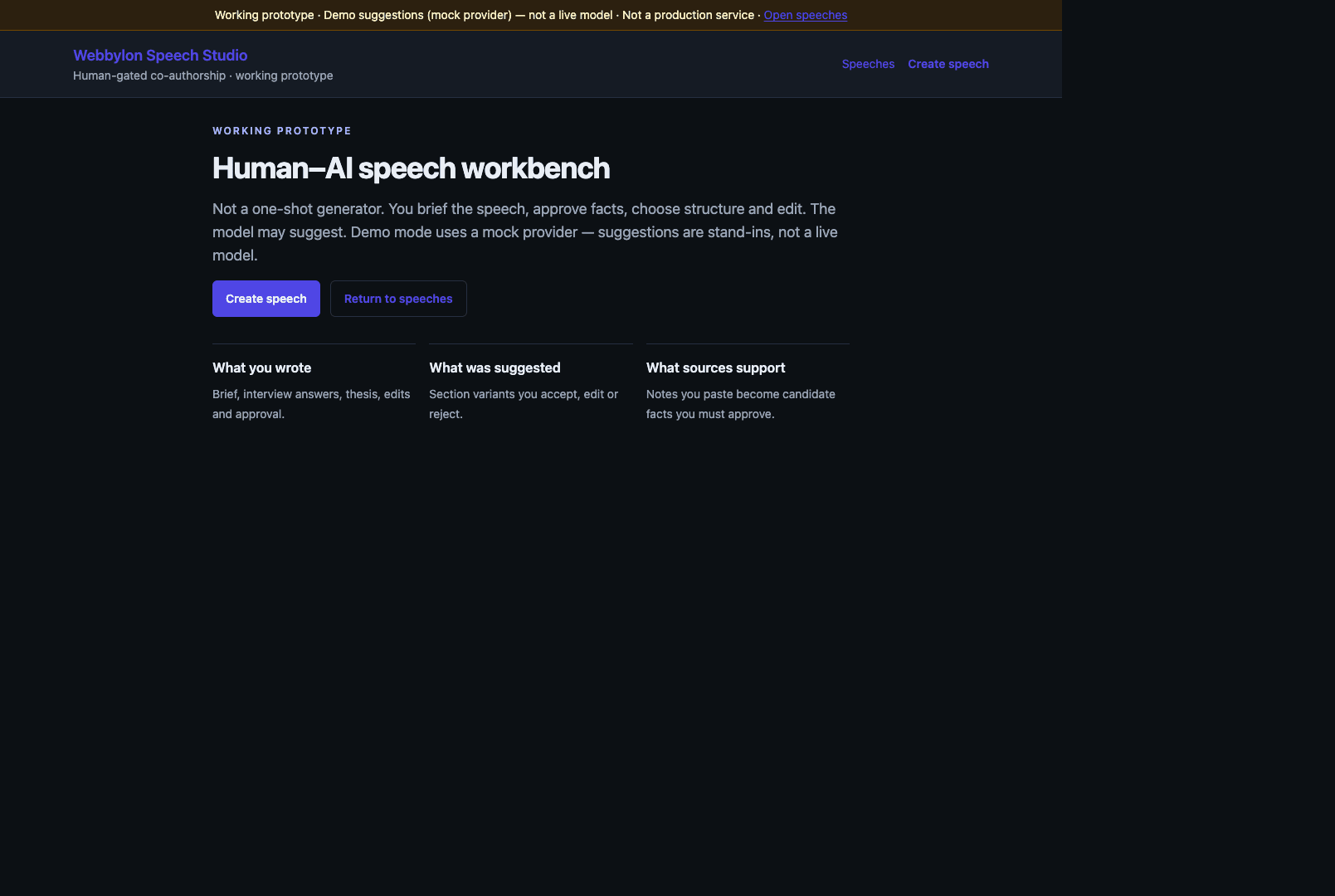
A working prototype where a speaker briefs, answers, approves facts and chooses structure. A model may suggest; it cannot emit a finished speech in one step.
The workflow can be demonstrated. It is not a production service.
Problem
Teams either draft slowly by hand or paste a prompt into a generator that has no provenance, no fact approval and no authorship boundary.
Users
Speakers, consultants and leaders preparing a professional talk. Demo content is synthetic.
Current solution
A staged workbench: brief, interview, research approval, thesis, architecture, outline, sections, edit and approval. Gates in the workflow block skipping. The default generation provider is mock.
Workflow
Creating a brief does not call a model. Source notes can be pasted and split into candidate facts that must be included. Later stages go through SpeechService and explicit gates. After section drafts exist, the manuscript is readable, copyable and exportable as Markdown. Default provider is mock.
01
Write a brief with no model call
02
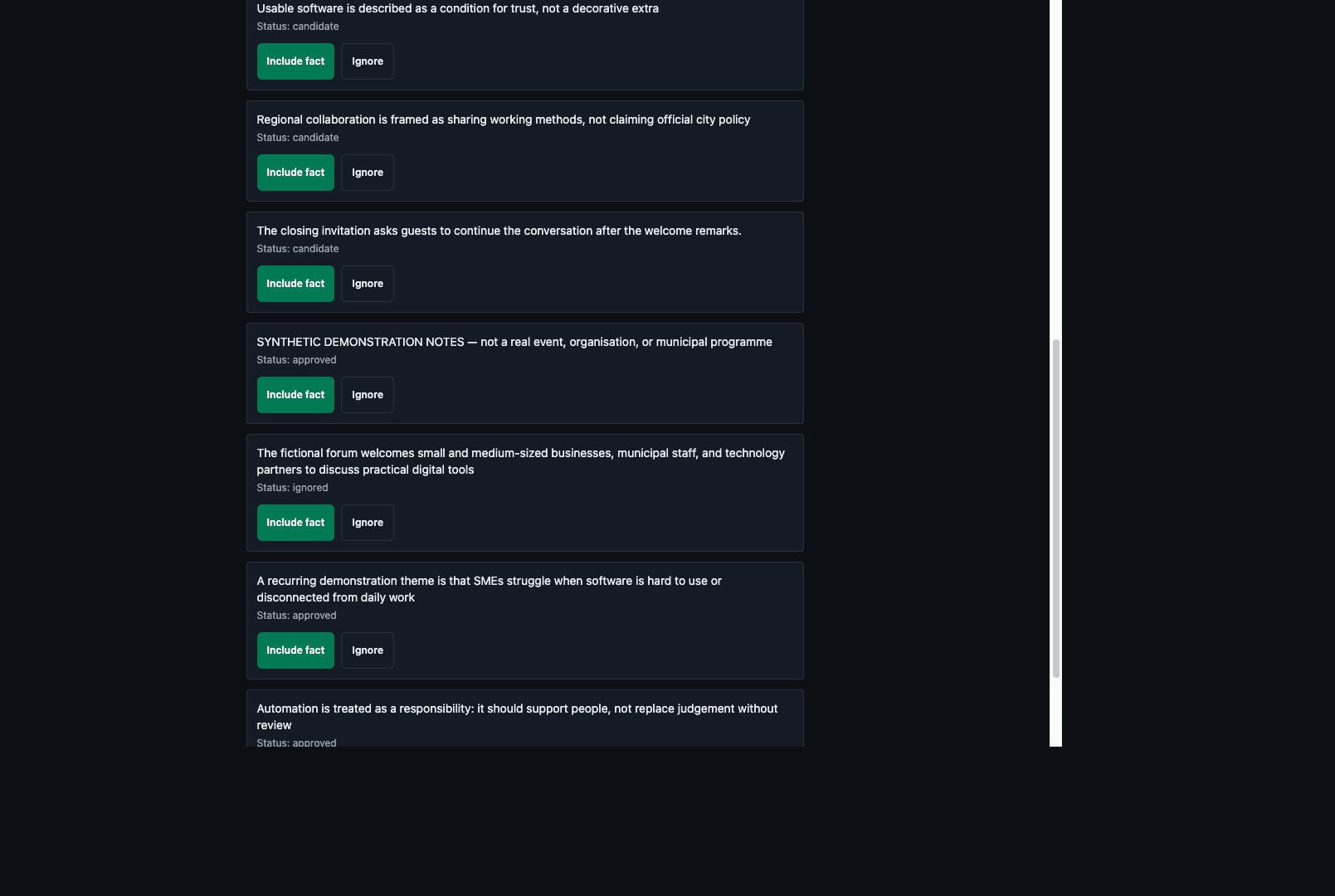
Paste source notes and include facts
03
Answer interview questions and set a thesis
04
Choose architecture and outline, then draft sections
05
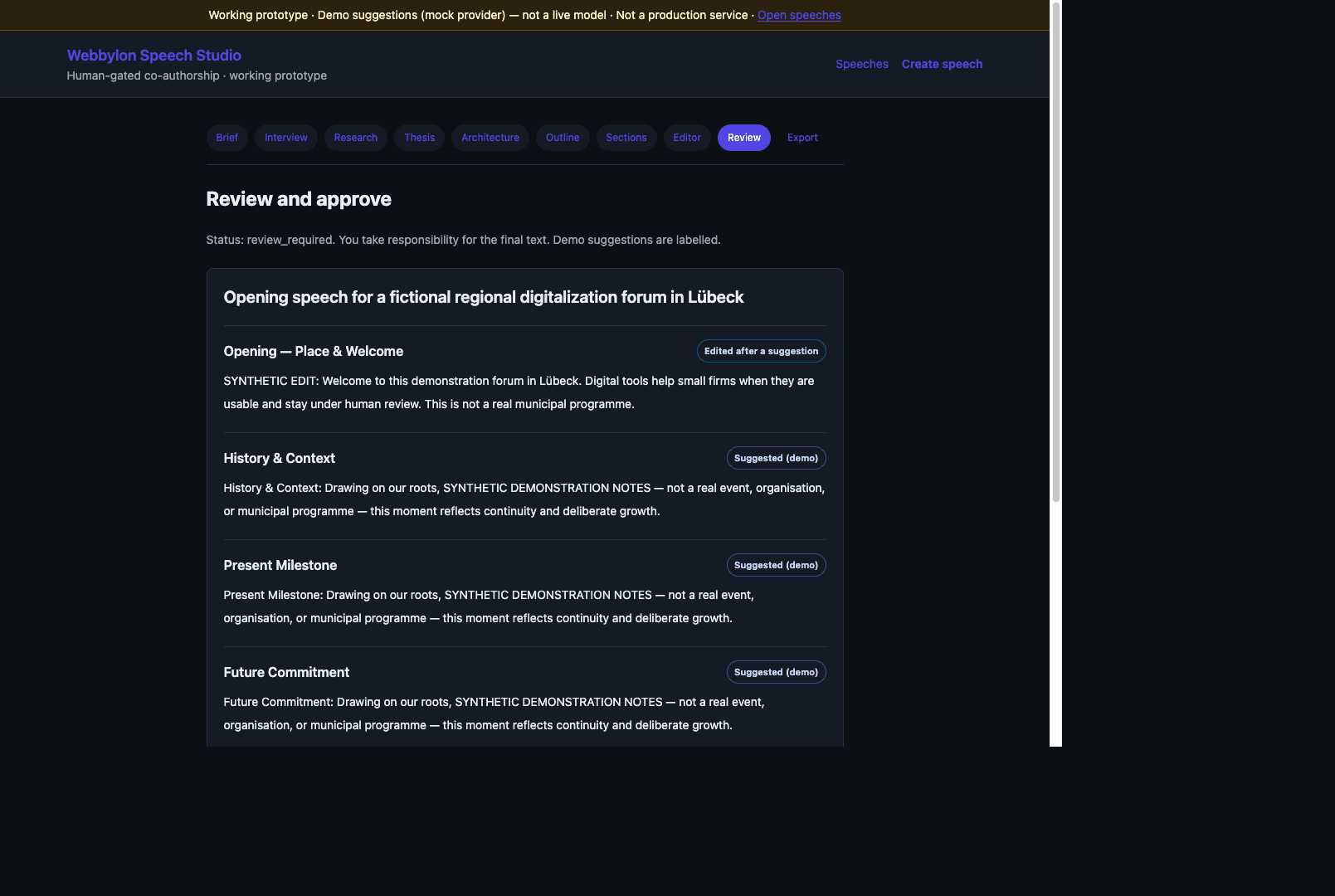
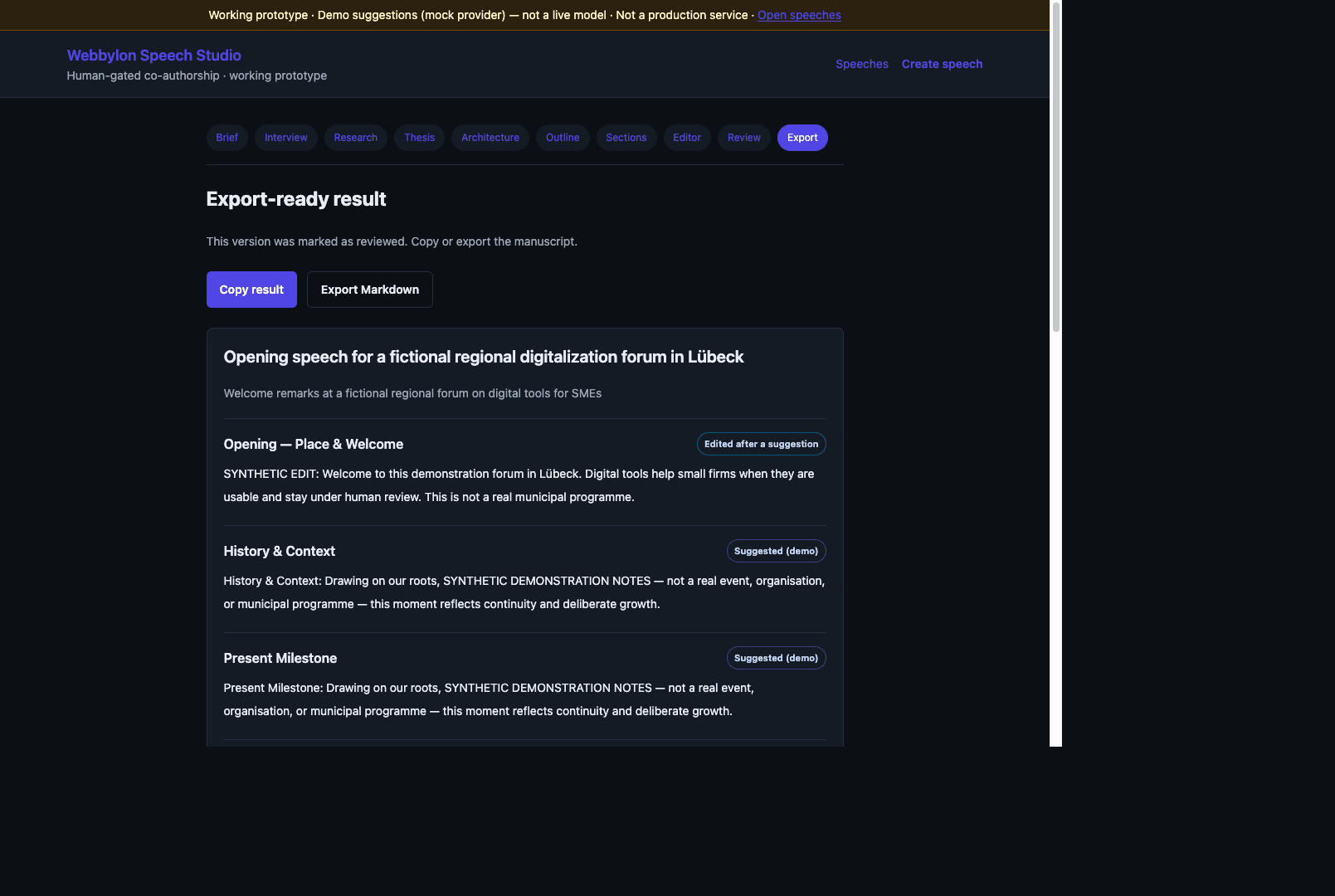
Review the manuscript, copy or export Markdown
Product experience
What exists today
The staged UI, local PostgreSQL persistence, source-notes input, readable review/export, mock provider and optional OpenAI adapter exist in a local prototype. There is no public production URL.
A speech can be created, reopened, fact-reviewed, edited and exported from the local database in mock mode. Empty briefs are rejected. One-shot generate-speech is blocked. Persistence failures do not claim a save.
Next milestone
Default suggestions are mock text. There is no public host, no authentication and no PDF export. Persistence is local PostgreSQL on port 5433.
A labelled live-model run behind the same gates, still with synthetic content, plus a hosted staging URL. Not claimed as done.
No public production URL.
Evidence
- Local prototype screens captured 2026-08-21 in mock mode after a persisted workflow: overview, source notes, manuscript review, export-ready Markdown
- Integration tests against PostgreSQL on port 5433: save/reopen, fact decisions, manuscript edits, reviewed state, Markdown export, zero OpenAI calls
- When the database is stopped, create/list show a service-unavailable message and do not claim a save
Commercial opportunity
Possible users: speakers, consultants, public-affairs and leadership communications. No paying customers are claimed.
Reusable capabilities
- Workflow gates as product rules, not UI copy
- Separation of mock and live model providers
- Authorship columns: what the human wrote, what the model suggested, what sources support
Current limitations
- Working prototype, not a production SaaS
- Default AI_PROVIDER is mock
- No public URL
- PostgreSQL on port 5433 is required to save and reopen a speech
What this shows about Webbylon
Webbylon can design AI features where the model stays behind human approval instead of replacing the author.
Investment relevance
Shows a governed-AI product pattern Webbylon can apply where unsupervised generation is not acceptable.
Use synthetic demo content only. Do not show real client speeches.
Implementation note
- Next.js workbench with workflow gates in TypeScript
- Mock provider by default; OpenAI is a swap-in adapter
Discuss this direction
The next step is a short conversation about the problem, the maturity, and the next credible milestone.